
Since the very start, Tibot has gathered opinions of farmers who rear breeding hens, laying hens or...
5 misconceptions about robotization
As in many industries, robotics has been used in poultry farming for a few years. Serving as a daily assistant, the poultry robot helps farmers save time and work in better conditions. Feeling skeptical? Discover the most common misconceptions about poultry robots and the explanations provided by the Tibot and Octopus Biosafety teams.
Summary
1. Poultry robots are bad for poultry
2. The poultry robot is just one more gizmo!
3. Technology is always complicated
4. A poultry robot must be difficult to maintain
5. A poultry robot is very expensive
1. Poultry robots are bad for poultry
With animal welfare being a top priority, you might be curious about how poultry respond to a robot in their environment. As the robot moves around the building to guide the poultry, it's reasonable to question its effects. Could it potentially harm the animals? Do hens or turkeys experience increased stress?
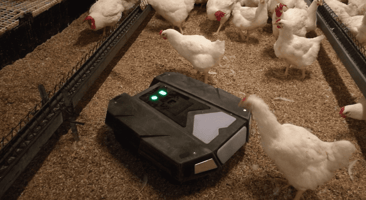
The answer to both questions is no! Poultry robots are specifically designed to fit into their surroundings and accommodate the way birds are raised. By making a few adjustments, you can ensure the animals are properly detected and stimulated. Once these measures are in place, your hens or turkeys remain safe. In fact, feedback from farmers indicates that the robot helps decrease behaviors like pecking. Practically speaking, the robot enhances the environment by providing a distraction; the birds have something to engage with, prompting them to move around and even follow it. Thus, the robot is highly beneficial for animal health. It functions like a fitness coach, keeping the animals in good physical condition while also reducing stress and aggression.
This effect has been noted by individuals like Fabien Le Bihan, a turkey farmer in Guiclan (Finistère, France). He has observed his animals becoming less anxious, which is advantageous during artificial insemination (AI).
"We observed this when the robot was used in half of the coop. The turkeys with the robot behaved differently from the others; they were calmer during AI. I could also mention that an active animal is healthier and less likely to brood. This will inevitably affect fertility and fecundity rates, which are crucial in our industry.”
2. The poultry robot is just one more gizmo!
Could you do without your automatic nests nowadays? In the same way that this equipment became established a decade ago, the poultry robot is becoming an essential piece of hardware. While it does not completely eliminate the need for you to go into your building, it does provide real benefits, which have been measured.
Lower percentage of floor eggs and increased productivity
By disturbing the birds, the robot encourages them to lay their eggs in the nest. This results in fewer low-grade eggs and a higher yield. Although the results vary depending on the breed and how the farmer uses the robot, they are always significant. Benoît Savary, who raises breeding hens in Bouchamps-lès-Craon (France), was thus able to reduce his percentage of floor eggs from 18 to 3% in fifteen days, on a 28-week-old flock, while going through his henhouse just twice to move the birds.
Better fertility
According to a study conducted by Hubbard, a global leader in broiler breeding, using the robot for two straight weeks increases mating by 30%, with the fertility rate improving by up to 5 points.
Saving time
Fewer floor eggs means less time spent picking up. Here again, the figures vary based on the unique features of the farm, but it's clear that the robot allows for less frequent visits to the building and more time for other farm activities. According to statistics carried out by the Tibot teams based on user feedback, the time saved per day is around 75/90 minutes for breeding hens, 90/120 minutes per day for breeding turkeys, and 45 minutes for laying hens.
3. Technology is always complicated
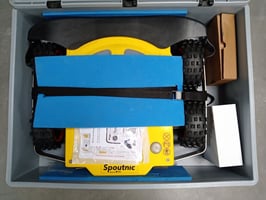
Technology does not have to mean complexity! In reality, using a poultry robot is very simple. Spoutnic requires no installation of software or hardware. You can turn it on right when you get it delivered.
The robot is fully designed to be easy to operate. Simply press a button to turn it on, and choose your settings on the controller. The robot's long battery life allows it to run within your coop all on its own for up to 10 hours. It’s equipped with a battery that can be recharged by plugging into a wall outlet.
That’s all there is to it! You keep total control of your farm: You’re the one who sets the start and end time, and you choose the most suitable stimuli based on what you know about your birds. Different sounds and lights, speed, optional waving flags: You get to decide what the robot does in the building. Our only recommendation is that you should vary the stimuli to keep the element of surprise and prevent the animals from getting too used to its presence.
4. A poultry robot must be difficult to maintain
Ruggedness is an important factor when designing a poultry robot. At Tibot, for example, we’ve opted for solid, top-quality materials, which makes Spoutnic one tough bot, as Edern, our customer support manager, explains:
"Product returns are extremely rare, and when they do happen, they’re ordinary things like a light bulb that went out. By contrast, there have been no failures related to the design. In three years, I’ve never had to change a single battery. The mustache, which is the part in front, can take millions of hits before it needs to be changed. The cover is also very strong; if the robot brushes against a feeding system bracket or if a hen pecks at it, it will be scratched, but not punctured. We did have a problem with version 2 of the robot: The chickens were tearing the LEDs off the cover. We replaced them with an LED strip fastened under the cover, but visible thanks to a transparent window. This is the advantage of having a small team where customer support and the research and development department are close to each other; when a problem is found on a farm, we respond immediately to solve it and make sure it doesn't happen again.”
In addition, disinfection is done by your usual protocol, such as in a nebulizer. Resistant to dust, ammonia and water, the poultry robot has been designed to keep dust or bacteria from accumulating. To clean it, just take off the wheels and spray them with a high-pressure jet, then wipe them with a sponge soaked in your disinfectant.
5. A poultry robot is very expensive
Sometimes farmers find the price of a poultry robot high, mostly by comparing it to something like a robotic lawnmower, or by assuming that it's "just a robot that runs", but a poultry robot is nothing like a lawnmower or a robo-vacuum: It requires a much greater technical effort to design, as it operates in challenging environments. In addition, it encounters moving obstacles (the birds), which it must not harm or panic.
Regardless of the technological challenge, the issue of price should be considered in terms of the benefits that can reasonably be expected. On this matter, farmers who use Spoutnic (which sells for €6800 - $8,000 ) indicate that their robot starts turning a profit in only 6 to 12 months.
Our teams carried out an experiment in a farm of 30,000 laying hens (Lohmann Blanche breed), comparing the results obtained between two different flocks (one with the robot, the other without). Over the flocks’ 77 weeks, with an egg price per kilo of €0.76 ($0,89), the farmer earned 400 eggs per nest per day with the robot, i.e. an estimated total gain of €10,240 ($12,000).
As you can see, a poultry robot is no mere high-tech toy! It’s good for the poultry and really improves the profitability of your farm, without being difficult to use or maintain. Want to do the math? Use our simulator to find out the real cost of floor eggs to you.